Agentic AI for Marketing: What It Means and Why It Matters

Written by Vinay Jain · Updated May 2026 · 9 min read
What Is Agentic AI for Marketing?
Something fundamental shifted in the AI landscape over the past year. We moved from tools that generate outputs to agents that accomplish goals. AI agents in marketing are no longer a concept — they’re shipping product.
The difference is not subtle. A tool waits for your input, processes it, and hands back a result. An agent receives a direction, researches what it needs, makes decisions, takes multi-step actions, corrects itself along the way, and delivers a finished outcome.
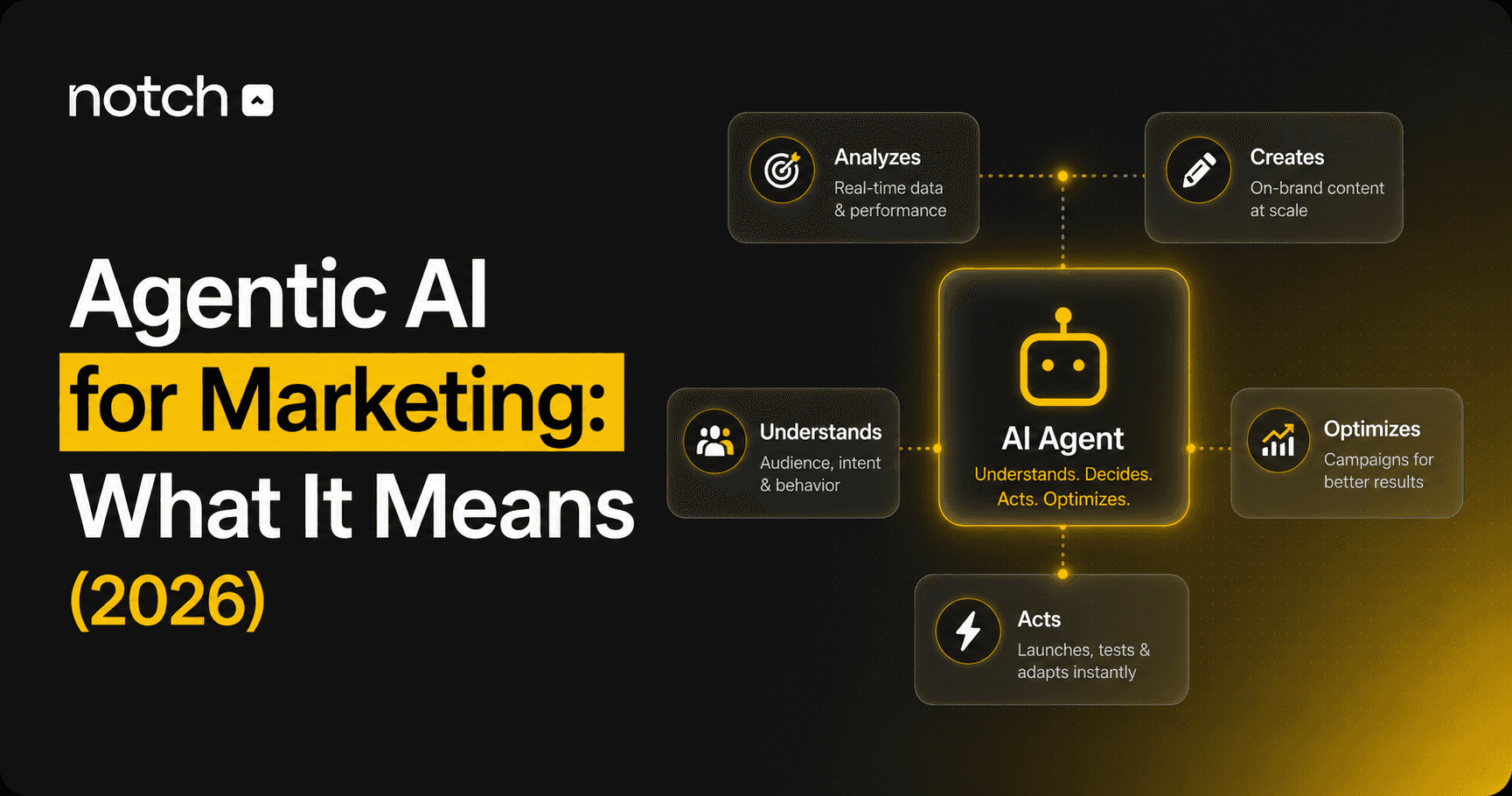
What is agentic AI for marketing? Agentic AI for marketing refers to AI systems that hold permanent brand context, take multi-step autonomous actions, and deliver finished work product — not just generated assets. Instead of operating multiple tools, marketers direct one intelligent agent that handles research, creation, and optimization end-to-end.
You have probably already experienced this shift if you work in software. Claude Code reads your entire codebase, understands your architecture, navigates files autonomously, and ships working features — all from a single natural-language direction. Devin operates as an AI software engineer that can plan, execute, debug, and deploy across complex engineering tasks. These are not autocomplete tools. They are context-loaded agents that operate with genuine autonomy.
The pattern is consistent: load the agent with deep context, give it a clear objective, and let it research, decide, act, and deliver. No micromanagement. No switching between six different tools. No re-explaining your project every session.
This pattern is now entering marketing — and agentic AI for marketing is quickly becoming the most important shift since programmatic buying. And it is going to change everything about how marketing teams operate.
The global agentic AI marketing market is projected to exceed $1.5 billion by 2027, with agentic systems expected to capture the fastest-growing segment as teams prioritize end-to-end automation over point solutions.
What Makes AI "Agentic"
Before we talk about marketing specifically, it is worth defining what separates agentic AI from the AI tools most marketers already use.
Traditional AI tools are reactive. You give them a prompt, they give you an output. You write a brief for a copywriting tool, it generates headlines. You upload an image to a design tool, it gives you variations. Every interaction starts from scratch. You are the intelligence layer — deciding what to do, in what order, with which tool, and how to stitch the outputs together.
Agentic AI is proactive and continuous. It holds context across an entire workflow. It breaks complex objectives into subtasks. It researches information it needs. It makes judgment calls about sequencing and approach. It self-corrects when something is off. And it maintains memory of your brand, your preferences, and your past work.
The five defining traits of agentic AI marketing systems:
Context permanence — The agent knows your project, brand, or codebase before you say a word. You do not re-brief it every session.
Multi-step reasoning — It breaks a goal into sequential actions and executes them in order, adjusting as it goes.
Tool orchestration — It uses multiple capabilities (research, generation, editing, analysis) as part of a single workflow, not as isolated features.
Self-correction — It evaluates its own outputs against the objective and iterates without waiting for you to flag issues.
Goal-oriented delivery — It does not just generate content. It delivers finished work product.
When you see these traits combined, the user experience changes fundamentally. You stop operating tools and start directing an intelligent system. This is the essence of agentic marketing automation — autonomous AI marketing systems that handle execution while you handle strategy.
How Is Agentic AI Used in Marketing Today?
Marketing is one of the most natural domains for agentic AI, and it is easy to see why. Agentic AI for marketing addresses the core pain: too many tools, too much context-switching, and too little strategic thinking time. Marketing work is context-heavy, repetitive at scale, and requires coordinating multiple skills and tools across every campaign.
To understand why agentic AI for marketing matters, consider how many distinct tasks go into a single marketing campaign: audience research, competitive analysis, messaging strategy, copywriting, visual design, video production, media buying, performance tracking, optimization, and reporting. Today, marketers juggle dozens of specialized tools across these functions, manually transferring context between each one.
Agentic AI for marketing has the potential to collapse these fragmented workflows into directed, intelligent systems. Here is where agentic AI for marketing is already beginning to show up:
Content Creation
AI writing tools have existed for years, but they remain largely stateless. Every blog post, email, or social caption starts with a blank prompt. Agentic content systems change this by maintaining your brand voice, editorial guidelines, audience personas, and content strategy as permanent context. You direct at the strategic level — "write a thought leadership piece on X targeting Y persona" — and the agent handles research, outlining, drafting, and formatting.
Campaign Management
Unlike traditional marketing automation that follows rigid rules, agentic AI makes adaptive decisions in real time. Campaign management involves dozens of micro-decisions: budget allocation across channels, audience segmentation, bid adjustments, creative rotation, and scheduling. Agentic AI systems can monitor performance data continuously, identify what is working, and make real-time adjustments without waiting for a human to pull a report and act on it.
Analytics and Reporting
Most marketing analytics today is still a manual process of pulling data from multiple platforms, building dashboards, and interpreting trends. Unlike traditional marketing automation dashboards, agentic analytics systems can continuously monitor your metrics, identify anomalies, surface insights proactively, and even recommend (or execute) optimizations based on what the data shows.
Ad Production
Of all the marketing functions where agentic AI for marketing creates impact, ad production stands out as the most transformative use case. It is also the one worth examining in depth, because it demonstrates the full power of the agentic pattern applied to a workflow that has remained stubbornly manual.
Why Ad Production Is the Biggest Agentic Opportunity
Ad production sits at the intersection of three factors that make it uniquely suited for agentic AI:
Highest manual overhead. Producing a single video ad today requires scripting, avatar or talent coordination, A-roll and B-roll sourcing, voiceover recording, editing, formatting for multiple placements, and iteration based on feedback. A single ad can take a team hours or days. Running tests at scale means multiplying that effort across dozens of variations.
Most repetitive. The core structure of ad production repeats across every campaign. Hook, problem, solution, CTA. The elements change, but the workflow is identical. This repetition makes it a prime candidate for an agent that can learn the pattern once and execute it indefinitely.
Most context-dependent. Good ads require deep knowledge of the brand, the product, the target audience, the competitive landscape, and what creative approaches are performing in the market right now. Every time a marketer opens a new tool, they have to re-inject all of this context manually. An agentic system that holds this context permanently eliminates the most time-consuming part of the process.
The current state of AI-assisted ad production reflects where AI tools were before the agentic shift. You have avatar generators like HeyGen. Cinematic video models like Runway and Sora. Template-based ad creators like AdCreative.ai. Quick UGC clip generators like Creatify. Editing tools like CapCut.
Each of these does one thing. You — the marketer — are the glue. You research hooks. You write scripts. You generate an avatar in one tool, source B-roll in another, record voiceover in a third, and edit in a fourth. You are the agent, orchestrating a fragmented pipeline.
How Is Agentic AI Different from Traditional Marketing Tools?
This is where the agentic model changes the game. Instead of operating five tools, you direct one agent.
Notch is building exactly this — an agentic video ads system that operates like a creative production team in a chat window. Before you type a single word, the agent already knows your brand: your colors, your tone, your product USPs, your approved hooks and CTAs, your uploaded B-roll assets. Your brand lives in what Notch calls Creative Brain — permanent memory the agent reads before every session.
You give it a direction: "Make me a 30-second hook-first ad for our summer campaign, UGC-style, targeting Gen Z, use the B-rolls from the last shoot."
The agent then:
Researches what hook formats are performing in your category right now
Writes a script with the right structure and tone
Generates or selects the avatar
Pulls in relevant B-roll contextually
Generates A-roll where needed
Adds voiceover
Assembles and edits the final video
You review. You direct adjustments in natural language. "The hook is not punchy enough." The agent rewrites and regenerates just that section. "Make the CTA more urgent." Done. "Give me five variations with different hooks." Done.
You never open a timeline editor. You never export to another tool. You never re-brief the agent on your brand. You stay in the conversation and direct.
This captures the three fundamental shifts that define agentic AI for marketing that define the move from AI tools to AI agents in marketing:
From tools to an agent. You stop operating multiple disconnected tools and start directing one intelligent system that handles the entire workflow.
From re-briefing to pre-loaded context. Your brand is not a session variable you paste into every prompt. It is permanent memory the agent reads before you say anything.
From generation to production. Other tools give you a clip or an asset. An agentic system gives you a finished ad — researched, scripted, assembled, edited, and ready to publish.
What This Means for Marketing Teams
The agentic AI for marketing shift does not eliminate marketing roles. It restructures them. The skills that matter change from tool operation to strategic direction.
When an agent handles research, scripting, generation, and editing, the marketer's job becomes:
Setting creative direction — What story are we telling? What angle are we taking? What emotion are we targeting?
Quality judgment — Is this on-brand? Does this hit the right tone? Will this resonate with our audience?
Strategic decisions — Which segments do we prioritize? What hypotheses do we test? How do we allocate across channels?
The operational layer — the hours spent context-switching between tools, manually assembling assets, reformatting for different placements — gets absorbed by the agent.
Marketing teams spend an estimated 60–70% of their time on operational execution — tool management, asset formatting, campaign setup — rather than strategic thinking. Agentic AI flips this ratio.
This means smaller teams can produce at the volume of much larger ones. A solo founder can run the kind of creative testing program that used to require an agency. A lean growth team can produce dozens of ad variations weekly instead of monthly.
Early adopters of agentic ad production systems report a 5x increase in creative output per team member, with no increase in headcount or budget.
How to Prepare for the Agentic Era
If you are a marketer watching the agentic AI for marketing shift unfold, here is what to focus on:
Document your brand context thoroughly. Agentic systems are only as good as the context they are loaded with. The teams that benefit most will be those with clearly defined brand guidelines, tone of voice documentation, audience personas, and creative frameworks. The better your context, the better your agent performs.
Shift your mindset from execution to direction. Practice thinking in terms of creative briefs and strategic objectives rather than tool-specific workflows. The marketers who thrive will be those who can clearly articulate what they want and evaluate what they get.
Start identifying your most repetitive workflows. Where do you spend the most time doing the same type of work with minor variations? Those are your highest-leverage opportunities for agentic AI.
Evaluate tools on autonomy, not features. When assessing AI marketing tools, stop asking "what can it generate?" and start asking "how much of the workflow can it handle end-to-end?" The feature list matters less than the degree of agency.
The agentic AI for marketing era is not coming. It is here. The question is not whether agents will handle your marketing workflows, but how quickly you adapt your team and processes to direct them effectively.
Frequently Asked Questions
What is the difference between agentic AI and regular AI tools in marketing?
Regular AI tools are reactive — you give a prompt, get an output, and the interaction ends. Agentic AI holds permanent context about your brand, takes multi-step actions autonomously, self-corrects, and delivers finished work product. The difference is between a calculator and an analyst.
Which marketing functions benefit most from agentic AI?
Ad production benefits the most due to its high manual overhead, repetitive workflow structure, and heavy context dependence. Content creation, campaign management, and analytics are also strong candidates, but ad production shows the highest ROI from agentic automation, making it the flagship use case for AI agents in marketing.
Will agentic AI replace marketing teams?
No — it restructures them. Agentic AI absorbs operational tasks like tool management, asset assembly, and campaign setup. Marketing roles shift from execution to strategic direction: setting creative vision, making quality judgments, and deciding what to test next.
How should I prepare my team for agentic AI?
Start by documenting your brand context thoroughly — tone, visual identity, audience personas, and creative frameworks. Then identify your most repetitive workflows. The better your context documentation, the more effectively an agentic system can operate on your behalf.
Ready to see agentic AI in action for ad production? Try Notch — the first fully agentic video ads platform that turns your creative direction into finished ads, with your brand context pre-loaded from day one.