AI-Powered Video Ads: How They Actually Work

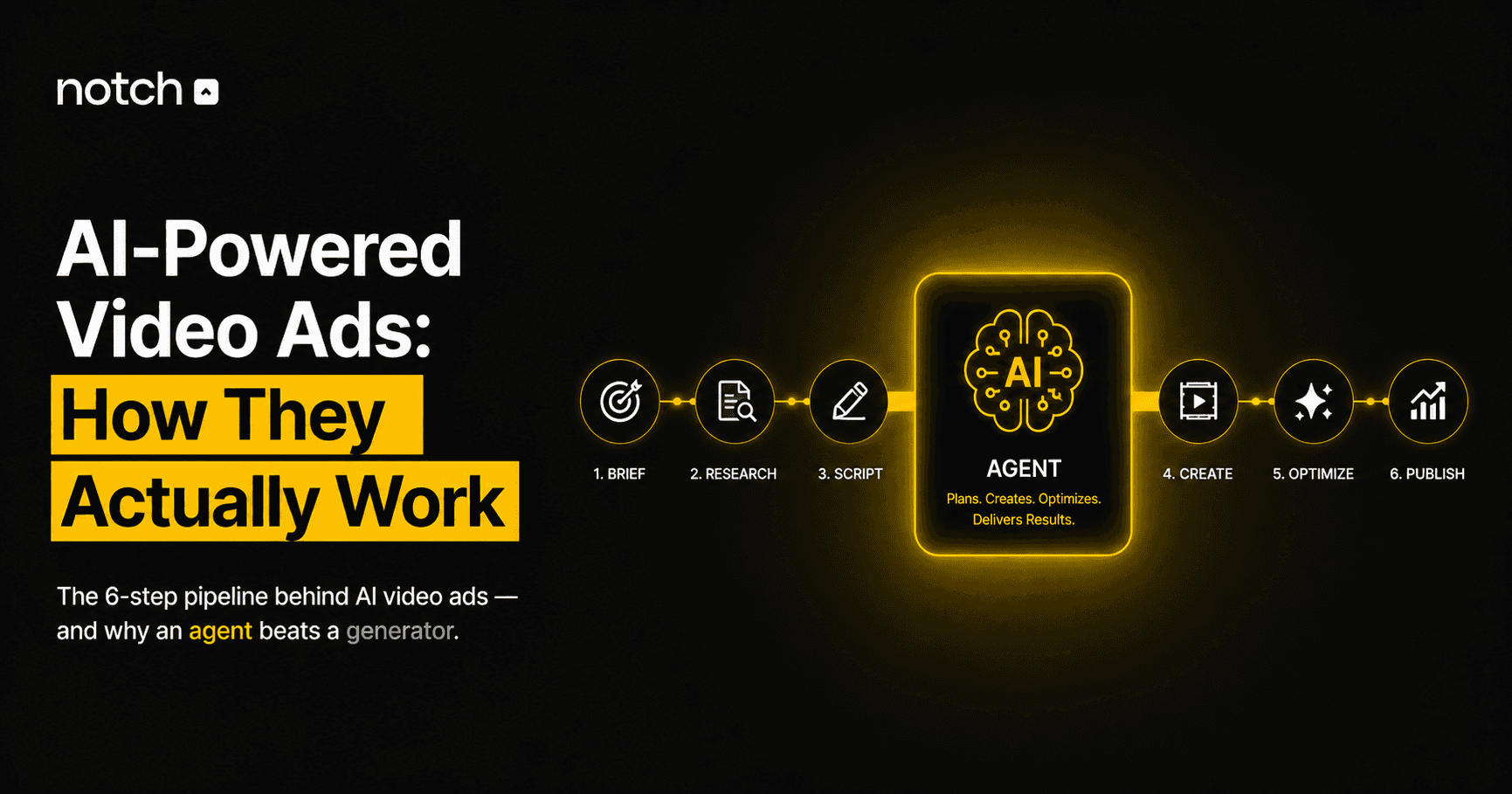
An AI-powered video ad is a video advertisement produced with AI handling the heavy lifting — script, visuals, avatar, voiceover, and editing — instead of a film crew and a timeline editor. The best ones today aren't generated in one click; they're built step by step by an agent that understands your brand.
What is an AI-powered video ad? An AI-powered video ad is a short video ad created using artificial intelligence to generate or assemble its parts — hooks and scripts, on-screen presenters (avatars), B-roll, voiceover, and the final edit. It lets one person produce in minutes what used to require a production team and days of work.
"AI video ad" gets used loosely, so let's be precise about how these are actually made, whether they perform, and where a true agent differs from a one-shot generator.
What is an AI-powered video ad?
At its simplest, it's a video ad where AI does the work a studio used to. That can mean a talking-head ad fronted by an AI avatar, a product demo generated from a URL, or a UGC-style clip that looks creator-shot but never involved a creator. The defining trait isn't the look — it's that the production pipeline is automated. For a deeper technical walkthrough of the underlying models, see how AI video ad generators actually work.
How do AI-powered video ads actually get made, step by step?
A finished, on-brand video ad comes together in six stages. A single-purpose tool does one of these; an agent does all of them in sequence:
Research & hook: the system studies what hooks are working for your category and drafts several openings.
Script: it writes a platform-native script (TikTok, Reels, Shorts) with the right pacing and CTA.
Avatar / A-roll: it generates a presenter or talking-head footage — your brand's spokesperson, consistent every time.
B-roll: it sources or generates supporting footage that matches the script.
Voiceover: it produces a natural voiceover, in the language and tone you specify.
Edit & assemble: it cuts everything together — captions, timing, music — into a finished, publishable ad.
The leap in 2026 is that these steps no longer live in six different tools you manually stitch together. That stitching was always the real work.
Are AI video ads good enough to run on Meta and TikTok?
Increasingly, yes — and the data backs it up. The platforms' own AI delivery systems reward creative volume and variety, and AI-produced ads are how teams supply that volume. Two realities make them work:
Native look beats polish. UGC-style and talking-head formats — exactly what AI produces well — consistently outperform overproduced spots on social.
Volume finds winners. Teams that test 10x more variations surface more outliers; AI makes that volume affordable.
The honest caveat: a single auto-generated clip with a generic hook won't beat a thoughtful ad. The win comes from directing the AI and testing many variations — not from one push of a button. That's why how you generate matters as much as what you generate.
How much faster is making video ads with AI vs manually?
The gap is an order of magnitude. A few reference points:
A traditional video ad takes a small team days to weeks from brief to export.
An AI-powered workflow produces a finished ad in minutes, and the next ten variations in minutes more.
Brands adopting AI creative report production cost reductions of up to 10x.
That speed is the entire point. It's not about replacing taste; it's about removing the days between having an idea and being able to test it.
What's the difference between an AI video generator and an agentic video ad agent?
This is the distinction that matters most. A generator takes a prompt and returns a clip — you still write the script, manage the brand, source the B-roll, and assemble the ad. An agent holds your brand context permanently and executes the whole pipeline from a direction like "make a 30-second hook-first ad for our new launch, UGC-style." We unpack this fully in what are agentic video ads, but the short version: a generator gives you a capability, an agent gives you a finished ad. Notch is the latter.
How do I create my first AI-powered video ad?
Start narrow. Pick one product, give the agent a direction, and review what comes back — then refine by directing, not by switching tools. Because your brand is pre-loaded, the second and tenth ads get faster, not slower. This is what makes AI-powered video ads practical for lean teams rather than just big brands with studios.
The future of video ad production isn't a faster editor. It's not having to open the editor at all.
Frequently asked questions
What is an AI-powered video ad?
A video ad where AI generates or assembles the components — script, avatar, B-roll, voiceover, and edit — instead of a production crew. It can be a talking-head ad, a product demo, or a UGC-style clip, all produced without a shoot.
Are AI video ads good enough to run as paid ads?
Yes, when you direct them well and test multiple variations. Native formats like UGC and talking-head ads perform strongly on Meta and TikTok, and the platforms' AI delivery rewards the creative volume AI makes possible.
How long does it take to make an AI video ad?
Minutes for a finished ad with an agentic workflow, versus days to weeks traditionally — and each additional variation is fast because the brand context is already loaded.
Is an AI video generator the same as Notch?
No. A generator returns a clip and leaves you to assemble the ad. Notch is an agent that scripts, generates, voices, and edits the finished ad end to end. See the difference on your own product.
Ready to make one? Direct your first AI-powered video ad with Notch — finished in minutes.
Keep reading