Why AI Ad Generators Aren’t Enough Anymore

Written by Vinay Jain · Updated May 2026 · 8 min read
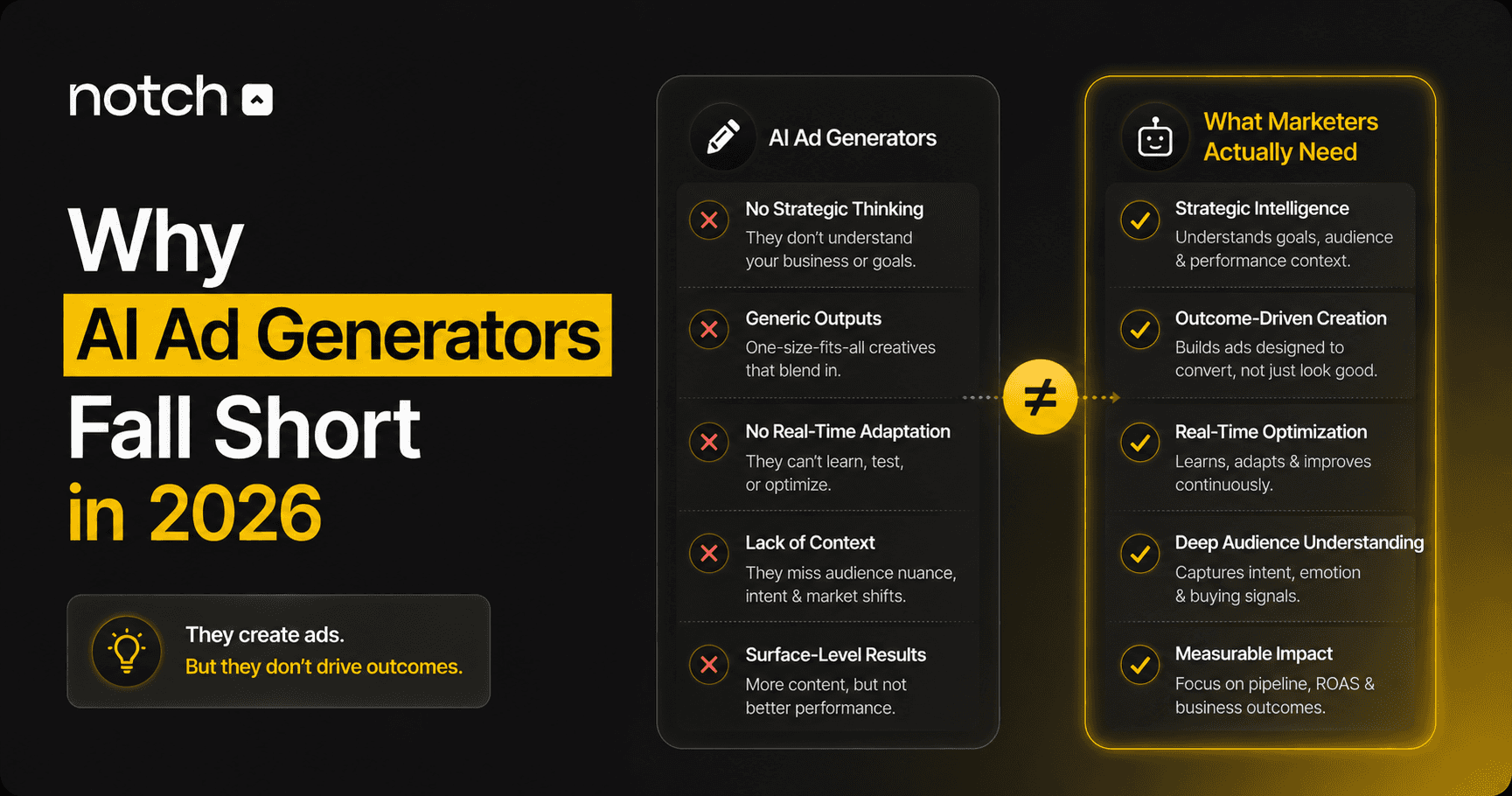
You were promised a revolution. AI ad generators were supposed to solve everything — but their limitations tell a different story.
AI ad generators arrived with a bold pitch: type a prompt, get a video ad. No more agencies. No more week-long production cycles. No more bottlenecks. No more bloated creative budgets. Just describe what you want, click generate, and watch the magic happen.
And for about five minutes, it felt real.
The first time you generated a talking avatar from a script you typed in, it was genuinely exciting. The first time a tool turned your product URL into a short video clip, you thought the game had changed. But AI ad generators aren’t enough for real production.
Then you tried to actually run ads at scale. And the cracks showed up fast. This is where AI ad generators fall short — not in what they generate, but in everything around it.
Why do AI ad generators fall short? AI ad generators automate individual production steps but leave you as the orchestrator between 4-6 disconnected tools. They lack brand memory, research capability, multi-step intelligence, and script control — forcing you to be the agent that holds context and manages the workflow manually.
Why Do AI Ad Generators Fall Short?
Here’s the pattern every marketer discovers after a few weeks with AI ad tools: the generation part works, but everything around it is still on you.
No brand memory. Every session starts from zero. You paste your URL again. These AI ad generator problems aren’t bugs — they’re architectural. You re-upload your logo. You re-explain your tone of voice, your target audience, your product positioning. The tool has no idea who you are, what you sell, or what worked last time. It’s like briefing a freelancer with amnesia — every single day.
No research capability. The tool cannot look at what hooks are trending in your category. It cannot analyze competitor ads. It cannot study what’s performing on TikTok or Meta right now. You have to do that research yourself, then manually feed the insights into the tool as part of your prompt.
No multi-step intelligence. Current AI ad generators run a model, not an agent. You give a prompt, you get an output. That’s it. There’s no sequential reasoning — no system that researches, then scripts, then generates, then edits, then refines based on your feedback. Each step is isolated. This is why AI ad generators fall short when you need volume.
No script control. Most tools decide the script for you based on a URL or a brief prompt. You get what the model decides. Want a specific hook-to-CTA structure? Want a founder story arc instead of a listicle format? Want the product reveal delayed until the final three seconds? Good luck communicating that to a one-shot generation model. The problems with AI ad generators compound the moment you try to control your own creative.
You are still the glue. This is the fundamental problem with AI ad generator limitations, and it’s why ai ad generator limitations are becoming a serious conversation among performance marketers.
What Are the Biggest AI Ad Generator Limitations?
Let’s map out what actually happens when you try to produce a high-quality video ad using today’s AI tools.
You start with research. You manually scan competitor ads, look at trending hooks, study what’s working in your vertical. That’s 30 minutes to an hour of your time.
Then you write a script. You open a doc, structure the hook, the problem statement, the solution, the CTA. Another 20 minutes if you’re fast.
Now you need an avatar. You go to HeyGen, pick a spokesperson, paste your script, configure the settings, and generate. HeyGen does avatars well — but that’s all it does. You export and move on.
You need B-roll — another bottleneck in the fragmented pipeline. You go to a stock library, or maybe Runway for something cinematic, or Higgsfield for product motion shots. Each tool does one thing. Each requires a separate upload, separate configuration, separate export.
You need voiceover. Another tool. You need editing — timing, cuts, captions, transitions. You open CapCut or Premiere. You import everything. You spend another hour on the timeline.
Six tools. Three hours. One ad. The bottleneck isn’t any single tool — it’s the glue work between them.
The average video ad produced through a multi-tool workflow requires 4-6 tool switches and 3-5 hours of production time — of which less than 30 minutes is actual creative decision-making.
This is why AI ad generators aren’t enough for serious performance marketing. And here’s the part that should bother you: each tool had no idea what the others were doing. HeyGen didn’t know your script strategy. Runway didn’t know your brand colors. CapCut didn’t know your hook structure. You were the only entity holding the full context. This is the clearest proof that AI ad generators fall short — they make you do the hardest work. You were the one making connections across tools, carrying brand knowledge from one tab to the next, stitching together outputs that were never designed to work together.
You were the agent.
And that’s exactly why ai ad generators fall short. They automate individual steps but leave the orchestration — the hardest, most time-consuming part — entirely to you.
Why This Is Getting Worse, Not Better
The irony is that as each individual tool gets better, the problem compounds.
HeyGen’s avatars look more realistic than ever. Runway’s cinematic generation is stunning — great for animated ad creation. Kling and Sora are pushing the boundaries of what’s possible with video generation. CapCut keeps adding AI-powered editing features.
But none of them are talking to each other. None of them hold your brand context. None of them can execute a multi-step production workflow without you manually connecting the dots.
This is precisely why AI ad generators fall short at scale: the tool landscape is getting wider and more capable at the individual level, while the glue work and integration burden on you keeps growing. More tools to evaluate. More exports to manage. More context to re-enter. More tabs to juggle. The limitations of AI ad tools become painfully obvious at this point — yet another reason AI ad generators fall short — a recipe for creative fatigue at every level.
Brands that consolidate their ad production into a single agentic system report producing 10-15x more creative variants per week with the same team size.
This is why the question isn’t “which AI ad generator is best?” anymore. The question is: why are you still the one doing all the work between these tools?
Creative fatigue accounts for an estimated 30-40% of ROAS decline in Meta ad accounts, yet most teams can only produce 5-10 new creatives per week through manual workflows.
What Should Replace AI Ad Generators?
Now you can see clearly why AI ad generators fall short. The missing piece isn’t better generation. Generation is solved. We have stunning avatars, cinematic B-roll, realistic voiceovers, and powerful editing engines.
What’s missing is intelligence continuity across the full production stack.
That means a system that:
Remembers your brand permanently — not per session, but always. Your colors, tone, product details, approved hooks, past creative directions, uploaded assets — all stored in a persistent Creative Brain. All of it, loaded before you type a single word.
Researches before it creates — looks at what’s working in your category, studies trending formats, analyzes hooks that are performing right now, and uses that intelligence to inform the creative.
Executes multi-step workflows — goes from research to script to avatar to B-roll to voiceover to edit in a single continuous chain, where each step is informed by the steps before it.
Gives you directorial control — lets you specify structure, tone, hook style, pacing, and product integration at a high level, then handles the execution. And lets you refine by giving feedback, not by re-entering a timeline — a true way to refresh your ads with AI.
Stays in one environment — no exporting, no tab-switching, no copy-pasting between tools. The entire production happens in a single conversation.
This is the difference between a tool and an agent. A tool runs a model and gives you an output. An agent holds context, takes sequential actions, makes decisions, and builds toward a goal across multiple steps.
The Agentic Alternative
This shift is already happening. The next generation of ad production isn’t about better generators — it’s about agentic systems that replace the workflow, not just the individual steps within it.
Think about how coding changed. We went from autocomplete (a tool) to AI coding agents that read your entire codebase, understand your architecture, take multi-step actions across files, and produce working features from high-level direction. The developer went from operator to director.
The same shift is coming for ad creative. Instead of operating six tools and being the glue between them, you direct one intelligent system that handles the full pipeline — with your brand permanently loaded, research built in, and the entire production stack unified.
At Notch, this is exactly what we’re building with Agentic Video Ads. A creative agent that’s pre-loaded with your brand’s complete context, researches what works, writes scripts, generates avatars and footage, edits the final video, and lets you refine through conversation — not through a timeline.
It’s not a better video generator. It’s the first time ad production has been fully agentic.
How Do You Evaluate AI Ad Tools Beyond Feature Lists?
If you’re evaluating AI ad solutions right now, here’s the framework that matters:
Does it remember your brand across sessions? If you’re re-uploading assets and re-explaining your brand every time, you’re using a tool, not an agent.
Can it research independently? If the system can’t look at trending hooks, competitor creative, or category-specific insights without you feeding them in manually, it’s missing a critical capability.
Does it handle the full production stack? Script, avatar, A-roll, B-roll, voiceover, editing, and final output — all in one system. If you’re still exporting from one tool and importing into another, you’re still the agent.
Can you direct it at a high level? You should be able to say “30-second hook-first ad, UGC style, targeting Gen Z, use the B-rolls from last shoot” and get a finished output. If the tool requires you to micro-manage every parameter, it’s not thinking — it’s just executing.
Can you refine through conversation? “The hook isn’t punchy enough. Make the CTA more urgent. Swap the B-roll in the middle.” If the system can adjust without you re-entering a timeline, that’s directorial control.
When AI ad generators aren’t enough to sustain your creative pipeline, it’s time for a fundamentally different approach. The era of one-trick AI ad generators is ending. The era of agentic ad production is starting. The question is whether you’ll keep being the glue between six tools — or start directing one system that does it all.
Frequently Asked Questions
Why can’t I just use multiple AI tools together?
You can, but you become the integration layer. Each tool starts from zero context every session. You re-upload brand assets, re-explain your audience, and manually transfer outputs between tools. The overhead of managing 4-6 tools often exceeds the time saved by any individual tool.
What is intelligence continuity in ad production?
Intelligence continuity means maintaining brand context, creative strategy, and production decisions across every step of the ad creation pipeline — from research to final edit. When context flows through the entire workflow without manual re-entry, production speed and brand consistency improve dramatically.
Is the problem with AI ad generators the quality of their output?
No. Individual AI tools produce impressive outputs — HeyGen avatars look realistic, Runway generates cinematic footage, and CapCut’s editing tools are powerful. The problem is the fragmented workflow between these tools, not the quality of any single tool’s output.
How do agentic systems solve the ad generator problem?
Agentic systems unify the entire production stack — research, scripting, avatar generation, B-roll, voiceover, and editing — under a single intelligent system with permanent brand memory. Instead of operating 6 tools, you direct one agent through natural conversation.
Ready to stop being the agent and start directing one? Try here