Creative Fatigue: Why Your Meta Ads Stop Working

Creative fatigue is the point where an ad's performance drops not because the targeting broke, but because the audience has seen the creative too many times and the algorithm has run out of fresh variations to test. The fix is rarely a new audience. It is more creative, produced faster than fatigue sets in.
What is creative fatigue? Creative fatigue is the decline in an ad's results (rising CPMs, falling CTR and ROAS) caused by overexposure of the same creative to the same audience. Modern ad algorithms need a constant supply of new creative to keep testing and serving — when production can't keep up, performance decays.
If you run paid social at any real spend, you have felt it: a winning ad that printed money for three weeks quietly stops working. You didn't change anything. That's creative fatigue, and on today's AI-driven ad platforms it arrives faster than ever.
What is creative fatigue, really?
Creative fatigue is an exposure problem, not a targeting problem. Every time a person sees the same ad, it converts a little less. Frequency climbs, click-through rate slides, CPMs rise as the platform works harder to place a stale asset, and ROAS follows them down. It is often confused with ad fatigue — but the two are not identical. Ad fatigue describes the audience seeing the same ad too often. Creative fatigue is the upstream cause: your creative supply can't keep pace with how fast the algorithm burns through it.
Why do my Meta ads stop performing after a few weeks?
Because Meta's delivery system is a testing machine, and it is starving. Since the shift to AI-driven, consolidated delivery (Advantage+ and the Andromeda model), the platform optimizes by continuously exploring creative variations and concentrating spend on winners. We covered the mechanics in our breakdown of Andromeda, but the headline is simple: the algorithm rewards volume and variety of creative. When you feed it five ads, it fatigues all five and has nothing left to rotate to. When you feed it fifty, it always has a fresh angle to serve.
What did 9 years inside Meta teach about the creative bottleneck?
Our co-founder Vinay spent nine years at Meta watching this problem form from the inside.
"Everyone blamed targeting when ads dipped. Inside, we knew the truth: the model wasn't short on audiences, it was short on creative. The single biggest unlock for advertisers was never a new audience setting — it was producing more good creative, faster. That's the bottleneck nobody outside the building could see." — Vinay, co-founder of Notch (9 years at Meta)
That insider view is why we built Notch. The platforms got brilliant at distributing creative. Production never caught up — and that gap is exactly where fatigue lives.
How many creatives does the algorithm actually need?
More than a human team can comfortably make. High-spending accounts commonly need 30–50+ fresh creatives per month per offer just to hold performance, and the most aggressive testers run far more. Three data points worth keeping in mind:
Top-performing paid social teams refresh winning creative every 7–14 days before fatigue compounds.
Accounts that test 10x more creative variations consistently find more outlier winners — testing volume, not cleverness, drives breakthroughs.
Manual production tops out at roughly 5–10 quality ads per week for most lean teams — an order of magnitude below what the algorithm will happily consume.
That math is the whole problem. The algorithm's appetite scaled. Your production capacity didn't.
How do you beat creative fatigue without burning out your team?
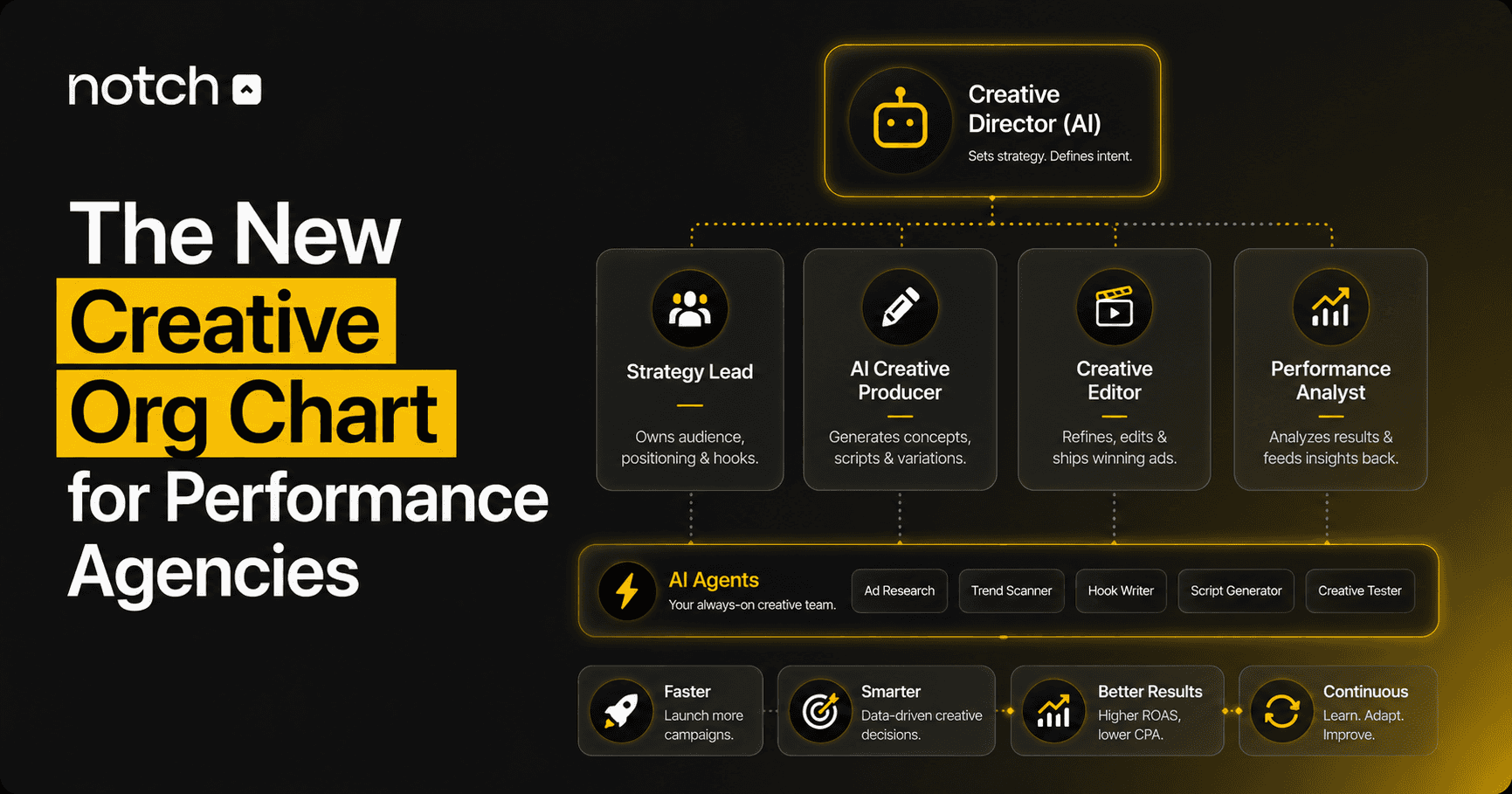
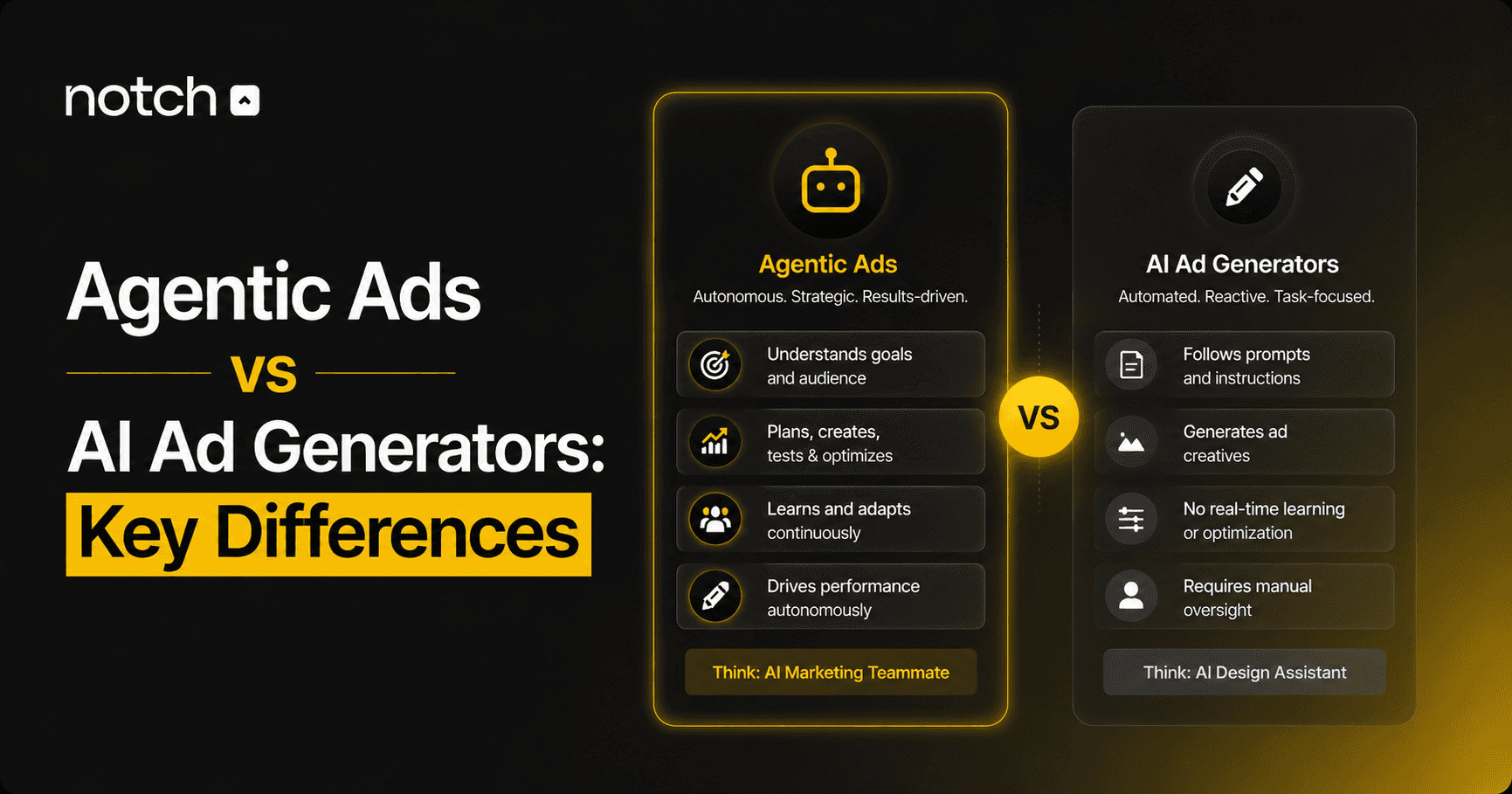
You change the unit of production. Instead of treating each ad as a hand-built project, you direct an agent to produce variations at the rate the algorithm consumes them. This is the core idea behind agentic video ads: not a generator that spits out one clip, but an agent pre-loaded with your brand that scripts, generates, voices, and edits finished ads — and then makes the next ten variations on command.
Practically, beating fatigue looks like this:
Produce in batches, not one-offs. Ship 10–30 variations of a winning concept so the algorithm always has a fresh angle to rotate to.
Refresh on a schedule. Replace fatiguing creative every 1–2 weeks before CPMs spike, not after.
Vary the hook, not just the colors. Real novelty resets attention; cosmetic tweaks don't.
Keep brand consistency automatic. When brand context is pre-loaded, volume doesn't cost you coherence.
Can agentic production actually keep up with the algorithm?
That is the entire reason agentic video ads exist. Notch holds your brand, product, and tone as permanent context, then builds finished video ads from a direction like "make me five hook-first variations of our summer offer." The result is production that scales with the algorithm's appetite instead of against it — which is exactly what performance marketers need to stay ahead of fatigue.
Creative fatigue isn't a flaw you can target your way out of. It's a supply problem. Solve the supply, and the dips stop.
Frequently asked questions
What is the difference between creative fatigue and ad fatigue?
Ad fatigue describes the audience seeing a specific ad too many times. Creative fatigue is the broader, upstream issue: your creative supply can't keep pace with how quickly the algorithm exhausts variations. Fix the supply and you fix both.
How often should I refresh ad creative to avoid fatigue?
Most high-spend accounts refresh winning creative every 7–14 days, and introduce fresh variations continuously rather than waiting for performance to drop. The exact cadence depends on spend and audience size — higher spend against a smaller audience fatigues faster.
How many ad creatives do I need per month?
For active accounts, 30–50+ fresh creatives per offer per month is a realistic floor to hold performance, with heavy testers running more. The constraint is almost always production capacity, which is why teams turn to agentic production.
Can AI fix creative fatigue?
AI generation alone helps with speed, but a single-output generator still leaves you assembling ads. An agentic system that scripts, generates, and edits finished variations on command is what actually matches the algorithm's appetite. Try it on your next campaign.
Stop targeting your way around a supply problem. See how Notch produces ad variations at the rate the algorithm consumes them.

Your competitors are hiring. So should you.


Resources
Socials